


…
Before you begin, remember that you have an index with the newsletter content organized by clicking below.

From macroeconomic releases to executable trading signals
Macroeconomic event trading depends on the information available when a decision is made and the price movement still accessible after execution. Using economic calendars, forecast surprises, macroeconomic state factors, and central bank communications, this framework connects incoming news to conditional return forecasts and feasible positions.
What’s inside:
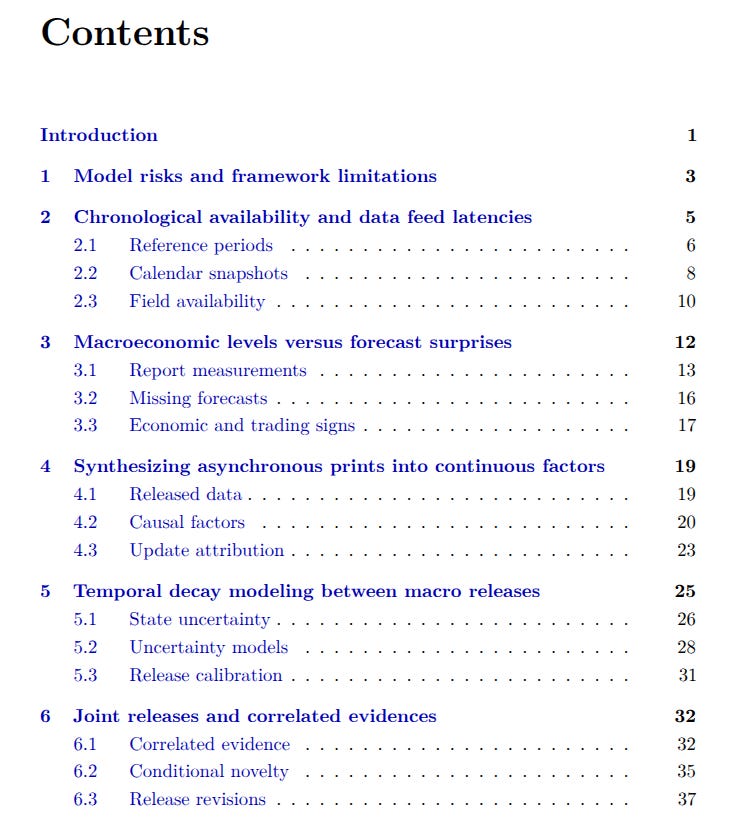
Risks and limitations: Examines sparse release histories, changing policy regimes, unreliable liquidity, and text-processing errors. Explains why statistical regularization cannot replace independent evidence, and how feed interruptions, imperfect timestamps, and optimistic execution assumptions can undermine an otherwise coherent research framework.
The information clock: Separates economic reference periods, publication, data receipt, feature completion, decisions, and fills. Covers calendar snapshots, forecasts frozen before publication, and field-level availability to reconstruct what a strategy could know at each decision point.
Economic levels versus forecast surprises: Distinguishes the economic state, deviations from consensus, internal-model innovations, revisions, and forecaster disagreement. Shows why an indicator can improve while disappointing expectations, and why substituting a previous observation for a missing forecast changes the signal being tested.
Daily macroeconomic states: Combines asynchronous activity, employment, and inflation releases into continuously available factors using recursively estimated principal components. Addresses historical scaling, changing indicator coverage, and factor-update attribution, while explaining why repeated daily values do not create additional independent observations.
Information age and uncertainty: Models how uncertainty grows between releases and contracts when new observations arrive. Separates publication age from the age of the measured economic period, compares state-space updates with age-weighted composites, and distinguishes uncertainty about economic conditions from asset-return volatility.
Joint releases and incremental news: Treats payrolls, unemployment, wages, and revisions as related components of a release package. Uses covariance shrinkage, multivariate surprise measures, and conditional residuals to assess unusual combinations and incremental information, while preserving the timing and historical versions of each component.
Policy narratives and text versions: Incorporates central bank statements and news through separate growth, employment, inflation, and policy-stance scores. Tracks document revisions, duplicate passages, model versions, and processing times so repeated reporting does not inflate the evidence and later interpretations do not enter earlier decisions.
Conditional forecasts and position sizing: Models how the same surprise can produce different price responses across economic environments and holding horizons. Combines surprises, the pre-release state, and selected regularized interactions, then sizes exposure using expected costs, return risk, model uncertainty, and market impact.
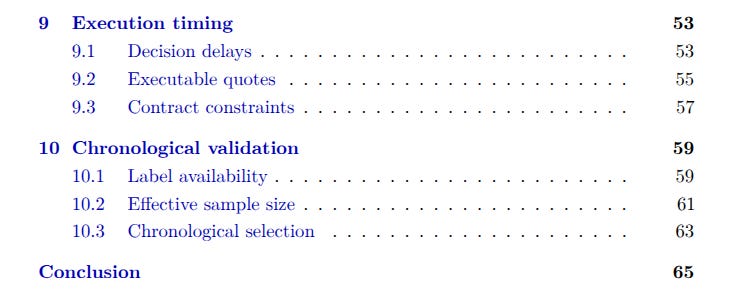
Execution and achievable returns: Measures performance from attainable fills and calculates cash results using executable bid and ask prices. Covers latency, spread widening, slippage, financing, partial fills, and broker constraints, including situations where minimum contract sizes make zero exposure the appropriate allocation.
Chronological validation: Builds training samples from fully observed outcomes, removes overlapping labels, and keeps related release components together. Uses chronological model selection, simple benchmarks, and portfolio accounting to assess whether additional complexity improves unseen forecasts and net returns within available capital.