
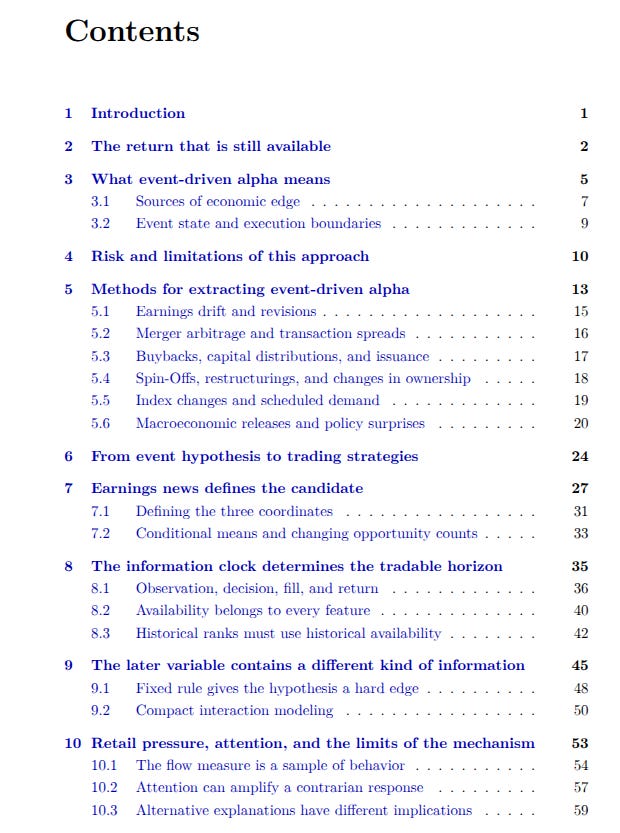
Before you begin, remember that you have an index with the newsletter content organized by clicking below.

From corporate catalysts to tradable event-driven alpha
Event-driven alpha depends on the return still available after a signal becomes observable and a trade executes. Using earnings surprises, pre-event momentum, and contrarian retail order flow, this framework separates historical event patterns from forward-looking forecasts and executable portfolios. The emphasis is on information timing, and incremental predictive value.
What’s inside:
What event-driven alpha means: Separates gross event returns from alpha by accounting for systematic exposures and execution costs. Explains why post-earnings drift, deal-completion risk, and mandatory index flows represent different economic opportunities rather than variations of one universal trading rule.
Risks and limitations: Examines the trade-off between waiting for clearer signals and losing the remaining opportunity. Covers noisy retail classification, clustered announcements, and specification search, alongside borrow fees, illiquidity, and short squeezes that can undermine attractive historical patterns.
Methods for extracting event-driven alpha: Reviews earnings drift, mergers, buybacks and issuance, spin-offs, restructurings, index changes, and macroeconomic releases. Connects each catalyst family to its own economic mechanism, modeling approach, and execution constraints, from continuous price adjustment to binary transaction outcomes and scheduled liquidity demand.
From hypothesis to trading rules: Turns a catalyst into an auditable signal by fixing the observation cutoff and attainable entry before testing thresholds. Requires retail flow to improve forecasts beyond earnings surprise, momentum, and the initial price reaction under comparable universe rules, trading costs, and execution assumptions.
Earnings news and conditional opportunities: Combines earnings surprise, prior momentum, and retail response to isolate specific post-announcement states. Historical patterns among prior losers with bad earnings and heavy retail buying motivate a short-focused hypothesis, while the weaker long-side evidence requires independent validation rather than assumed symmetry.
The information clock: Aligns observation, execution, and return measurement to prevent crediting the strategy with unavailable gains. The daily example observes flow through day +1, enters at the day +2 close, and exits on day +22, producing twenty daily return observations—not a fresh twenty-two-session holding period.
Early signals and predictive models: Demonstrates how completed-window retail flow can absorb information from the outcome being predicted. One synthetic example illustrates this leakage, while fixed quintile rules and compact interaction models provide alternative ways to express the early-flow hypothesis without treating retrospective classifications as executable signals.