

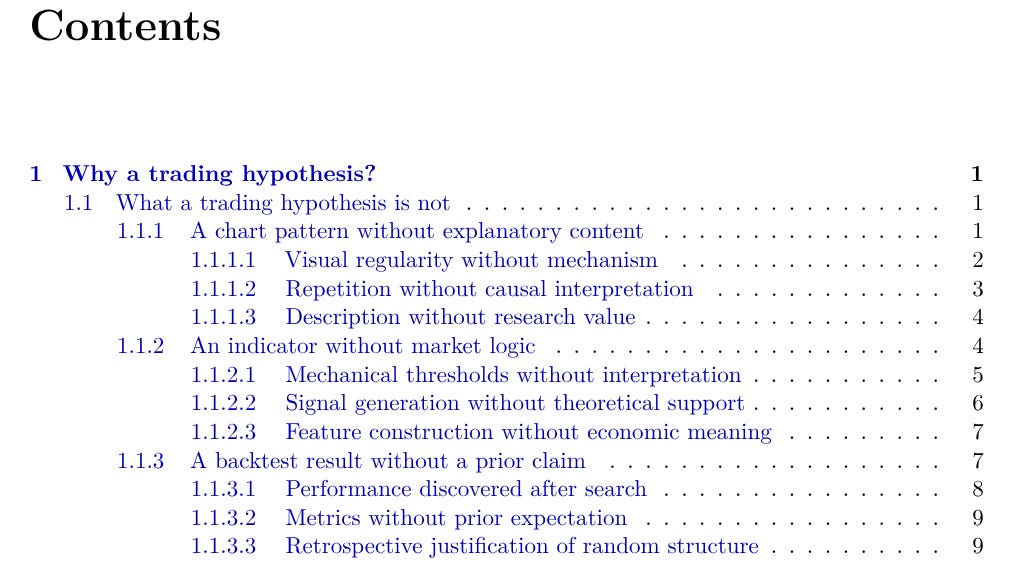
Before you begin, remember that you have an index with the newsletter content organized by clicking on the image below.

What a trading hypothesis is not
The lecture explains that charts, indicators, and backtests can all be useful, but none of them are complete hypotheses on their own. Their value appears only when they are connected to mechanism, scope, timing, variable design, and evidence, so the researcher can move from surface regularity to a claim that can be tested, challenged, and refined.
What’s inside:
What a trading hypothesis is not. The lecture begins by separating a genuine hypothesis from three incomplete objects (a chart pattern, an indicator, and a backtest result).
A chart pattern without explanatory content. A visual formation may reveal tension, compression, rupture, or recovery, but it remains only an empirical clue until the researcher explains what market process could have produced it.
Visual regularity without mechanism. Repeated shapes on a chart can create the impression of structure, but research begins only when those shapes are translated into participants, frictions, information, liquidity, or structural relations.
Repetition without causal interpretation. A pattern that appears many times does not automatically become a hypothesis. Repetition gains research value only when it is linked to a stable cause and a clear condition under which it should persist or disappear.
Description without research value. Statements such as “price tends to bounce after strong declines” are useful starting observations, but they need scope, variables, comparison design, and evidence criteria before they become researchable.
An indicator without market logic. Indicators compress data into signals, thresholds, scores, or ratios, but they matter scientifically only when they represent a real market condition such as crowding, strain, dislocation, liquidity withdrawal, or delayed adjustment.
A backtest result without a prior claim. A good historical result is not enough. The lecture emphasizes that a backtest should examine a claim stated in advance, rather than becoming a machine for discovering attractive performance and inventing explanations afterward.
The importance of forward logic. Strong research moves from observation to mechanism, from mechanism to formal claim, and from claim to evidence. This order gives meaning to both success and failure, allowing the researcher to learn from the market rather than simply collect historical artifacts.