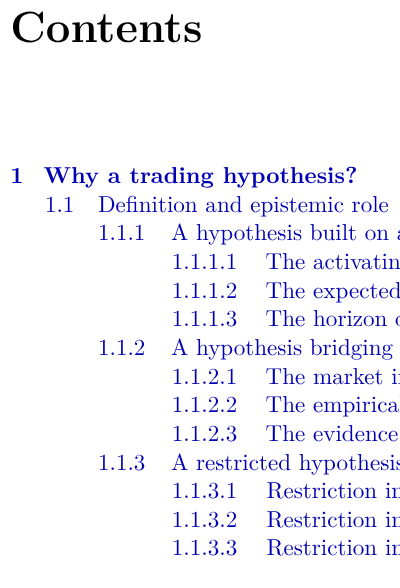

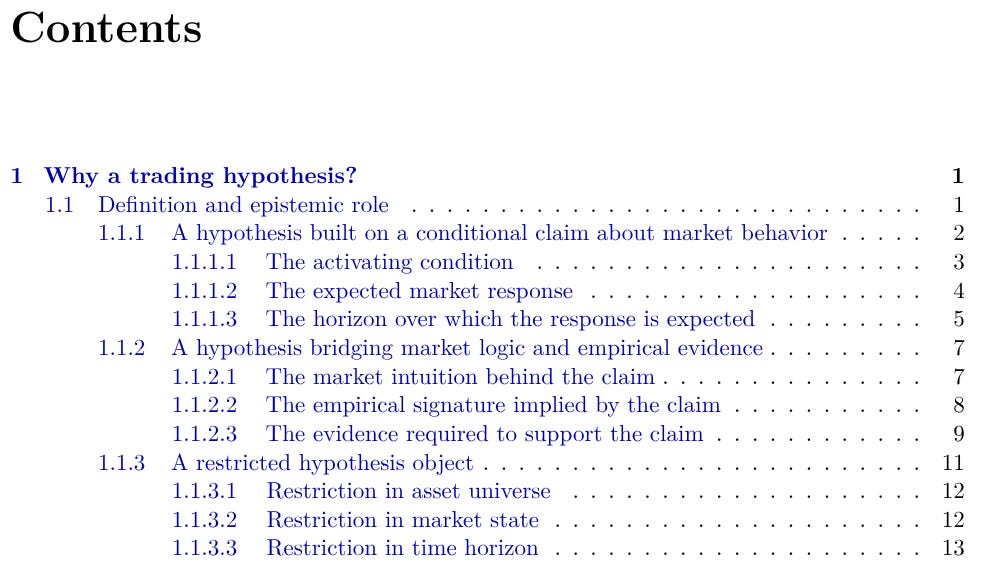
Before you begin, remember that you have an index with the newsletter content organized by clicking on the image below.

Why a trading hypothesis?
A trading hypothesis is presented as the first scientific form of a market idea, one that transforms intuition into a structured claim with an activating condition, an expected response, a time horizon, and a proposed mechanism. The lecture develops this framework as the bridge between market logic and empirical evidence, and explains how restriction, precision, and coherence turn a vague observation into a research object that can be tested, challenged, and refined.
What’s inside:
Why a trading hypothesis matters. A trading hypothesis is the first formal research object in quantitative trading because it gives direction, causal meaning, and empirical consequences to an otherwise informal market observation.
Hypothesis as a conditional claim about market behavior. The lecture defines a genuine hypothesis as a structured conditional statement that specifies when a market condition appears, what response should follow, over what horizon, and because of what underlying process.
The activating condition. A hypothesis begins with a trigger that identifies when the market enters a meaningful state, such as a volatility expansion, spread dislocation, order flow imbalance, or liquidity shock, so the sample becomes selective in a principled way.
The expected market response. The claim must state what should happen after activation by defining the object of movement, the direction of adjustment, and the scale or relevance of that movement, so the idea acquires a clear empirical identity.
The horizon over which the response should emerge. Time is treated as part of the hypothesis itself because different mechanisms operate on different clocks, and the validity of the research depends on matching the response window to the real rhythm of the market process.
A bridge between market logic and empirical evidence. The lecture shows that a good hypothesis connects two domains at once, the logic of participants, frictions, and structural forces on one side, and the language of variables, samples, outcomes, and comparisons on the other.
Empirical signature and supporting evidence. A strong hypothesis does not predict profitability alone, but a specific patterned trace in the data, including direction, structure, timing, conditional strength, and comparative contrast, so support comes from alignment rather than from one backtest statistic.
The hypothesis as a restricted object. The lecture explains that every valid hypothesis must be restricted to a coherent asset universe, a defined market state, and a proper time horizon, because restriction is what gives the claim scientific shape and protects it from vague breadth.