


Before you begin, remember that you have an index with the newsletter content organized by clicking below.

From a broad insights to a focused research question
Quantitative research starts before any dataset is downloaded or model is built. The first task is to choose an economic process worth explaining, identify the people, claims, constraints, and events that shape it, and decide which part of that process deserves attention. From there, the researcher uses existing knowledge and available evidence to locate what remains unexplained. The scope is then narrowed until the question captures a specific decision, an observable sequence, and a genuine uncertainty without stripping away the mechanism that makes the problem interesting.
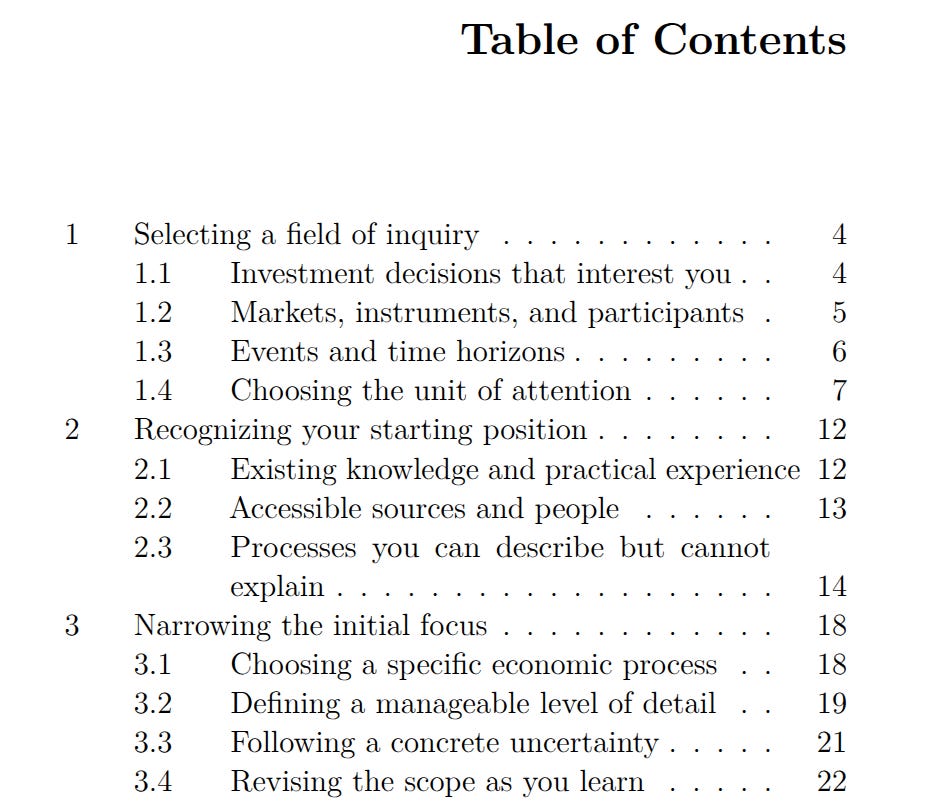
What’s inside:
Selecting a field of inquiry: Start with a decision or economic puzzle rather than a broad asset class. The goal is to find a process whose incentives, constraints, and consequences can be traced clearly enough to support sustained research.
Identifying markets, claims, and participants: Different securities create different rights and obligations, while investors act under different motives and constraints. Include only the participants needed to explain the transaction, adding others when they materially change the mechanism.
Defining events, horizons, and the unit of attention: Information releases, contractual deadlines, settlements, and other events change what participants know or can do. Choose whether the main lens is the asset, the investor’s decision, or the institution and market rules that make the action possible.
Recognizing your starting position: Existing knowledge, practical experience, accessible documents, and conversations determine which mechanisms you can examine well. They also create blind spots, so prior familiarity should be treated as a starting point rather than evidence that the process is already understood.
Finding what you can describe but cannot explain: Familiar terms and recurring market patterns often hide the actual mechanism. Break the process into actors, actions, constraints, cash flows, and claims, then identify the exact link where the explanation stops.
Narrowing the research process: Replace broad themes such as liquidity, management quality, or financing conditions with a concrete sequence in which resources are committed, transferred, or constrained. Set an observable starting point and endpoint while keeping the economic consequence inside the research boundary.
Following a concrete uncertainty and revising the scope: State what remains unknown and allow several explanations to compete. Keep details that change the economic explanation, remove those that do not, and revise the research boundary when new evidence reveals that a different relationship actually governs the decision.