

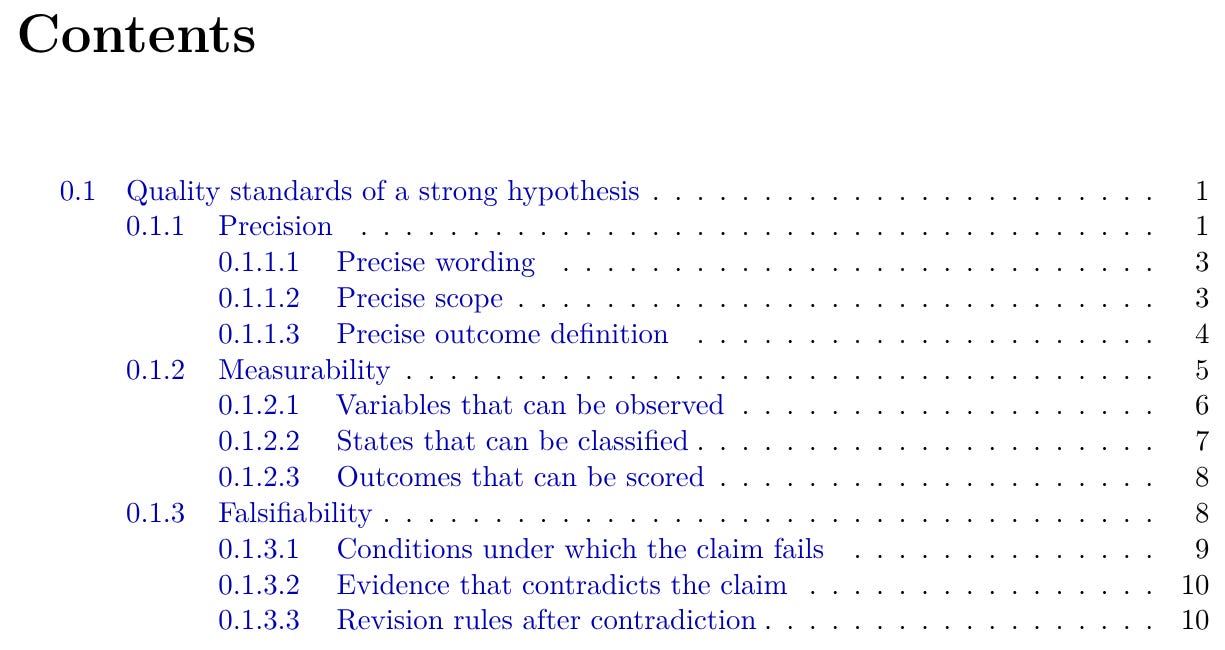
Before you begin, remember that you have an index with the newsletter content organized by clicking on the image below.

Quality standards of a strong trading hypothesis
A strong trading hypothesis turns a market idea into an research object. It defines what is claimed, where the claim applies, how the effect appears in data, and how evidence improves the hypothesis over time. Precision, measurability, and falsifiability give the hypothesis structure and make the research process coherent, testable, and repeatable.
What’s inside:
Precision. A strong hypothesis defines the exact claim, the market setting, and the expected response.
Precise wording. Clear wording transforms broad ideas such as pressure, stress, momentum, or dislocation into specific market processes.
Precise scope. The hypothesis identifies the asset universe, market state, event type, time horizon, and environment where the effect belongs.
Precise outcome definition. The research defines the empirical object used to judge the effect, such as return, spread compression, rank shift, abnormal movement, path behavior, or persistence.
Measurability. The hypothesis enters the data through observable variables, classifiable states, and outcomes that can be scored consistently.
Observable variables and classifiable states. Market concepts such as crowding, hidden demand, liquidity pressure, or absorption become defensible proxies and coherent state definitions.
Falsifiability. The hypothesis exposes the claim to evidence by defining the conditions that weaken, contradict, or challenge the proposed mechanism.
Revision after contradiction. Evidence improves the hypothesis by narrowing the trigger, refining the state filter, adjusting the horizon, improving the outcome, or replacing the mechanism when needed.