


Before you begin, remember that you have an index with the newsletter content organized by clicking below.

From research question to testable hypothesis
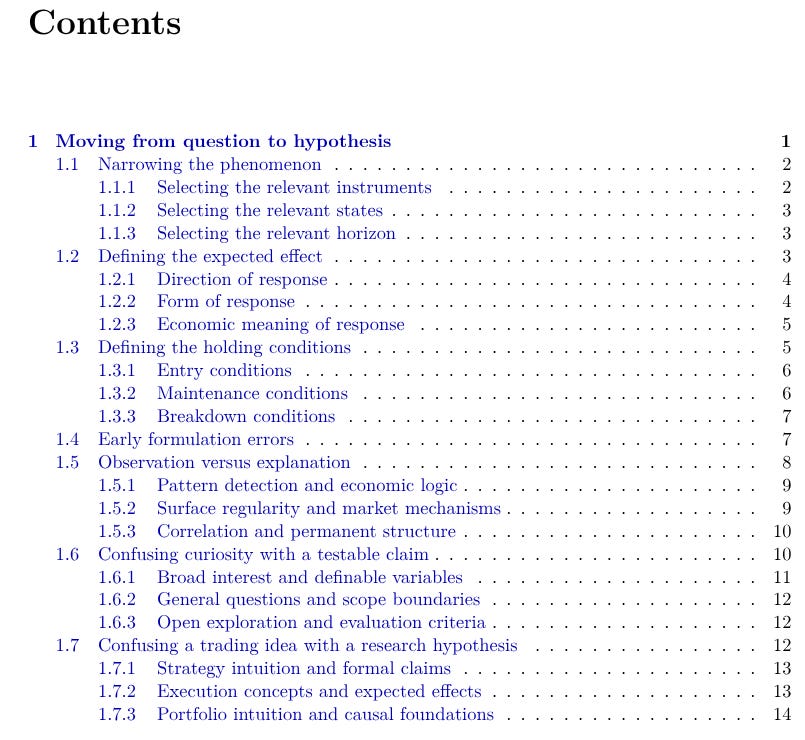
Quantitative trading research begins with market intuition, but it becomes empirically useful only when the researcher defines the instruments, market state, activation trigger, response window, expected price path, and causal mechanism. Strong hypothesis fixes these elements before testing, separates the source of the edge from its execution, and establishes the conditions under which the claim remains valid or expires.
What’s inside:
Narrowing the phenomenon: The researcher reduces a broad market observation to a specific inefficiency by defining the relevant instruments, environmental state, and natural time horizon.
Selecting instruments, states, and horizons: Assets should be close to the source of the market force, conditions should support the proposed mechanism, and the holding period should match the speed at which the effect unfolds.
Defining the expected effect: The hypothesis specifies the direction, shape, magnitude, duration, and decay of the anticipated response, including mean reversion, continuation, spread compression, or ranking changes.
Connecting price action to economic meaning: Expected returns require a causal explanation based on information diffusion, liquidity recovery, forced order flow, institutional execution, funding constraints, or another identifiable market process.
Defining the trade lifecycle: Entry conditions activate the claim, maintenance conditions verify that its mechanism remains present, and breakdown conditions identify when the original hypothesis has expired.
Separating observation from explanation: Similar chart patterns can emerge from different forces. Research must look beyond visual geometry to identify participants, incentives, liquidity constraints, venues, and transmission channels.
Separating idea, hypothesis, and execution: A trading idea provides intuition, the research hypothesis identifies the source of predictive value, and the execution method determines how to capture it. Each portfolio component must possess its own causal foundation.