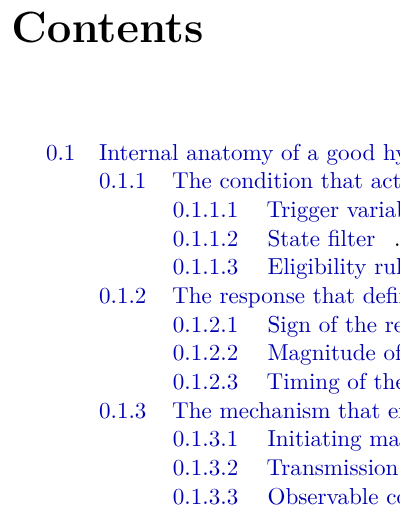

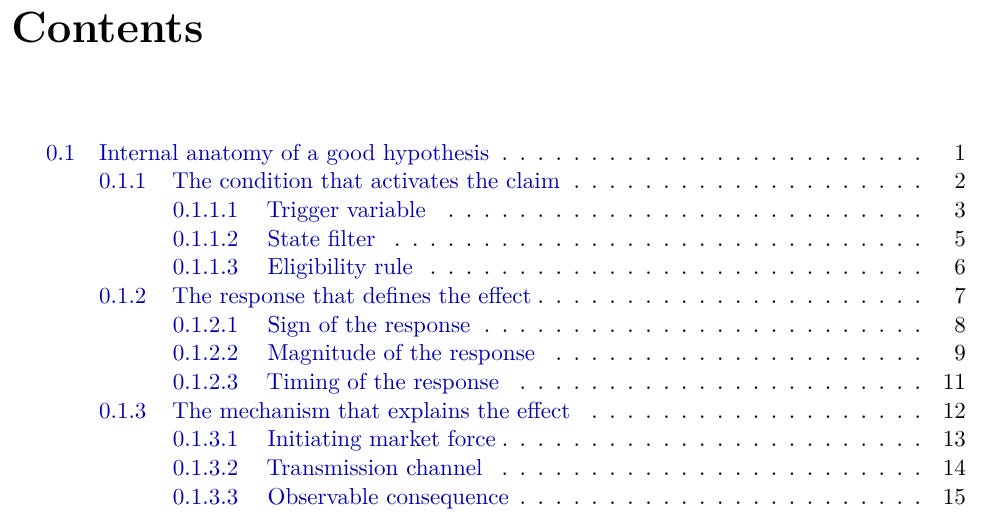
Before you begin, remember that you have an index with the newsletter content organized by clicking on the image below.

Internal anatomy of a good hypothesis
A genuine hypothesis has an internal structure. It defines when the claim begins, what market response should appear, and why that response should emerge. Its value comes from connecting activation, response, mechanism, and evidence into one coherent research object that can be tested, challenged, refined, and extended.
What’s inside:
Internal anatomy of a good hypothesis. The lecture presents a hypothesis as an organized structure whose parts must fit together.
The condition that activates the claim. A hypothesis begins by identifying the market state in which the effect should appear.
Trigger variable. The trigger translates pressure, dislocation, surprise, imbalance, or regime transition into a variable that can select relevant episodes.
State filter. The state filter places the trigger inside the right market environment.
Eligibility rule. The eligibility rule protects the empirical sample and decides which observations belong to the same research object by controlling for trading session, liquidity, data quality, structural breaks, and special distortions.
The response that defines the effect. A hypothesis must specify what should happen after activation.
Sign, magnitude, and timing. Sign defines direction, such as continuation, reversal, convergence, or divergence. Magnitude defines economic substance after costs and frictions. Timing defines the internal path of adjustment after the trigger appears.
The mechanism that explains the effect. The final part explains why the trigger should lead to the response.