

Before you begin, remember that you have an index with the newsletter content organized by clicking below.

From market observation to research question
The process begins with visible market behavior, but it becomes useful only when the researcher defines the phenomenon, classifies the market setting, identifies the mechanism, specifies the scope, and formulates a testable claim. Strong research moves from intuition toward measurable, comparable, and falsifiable market processes.
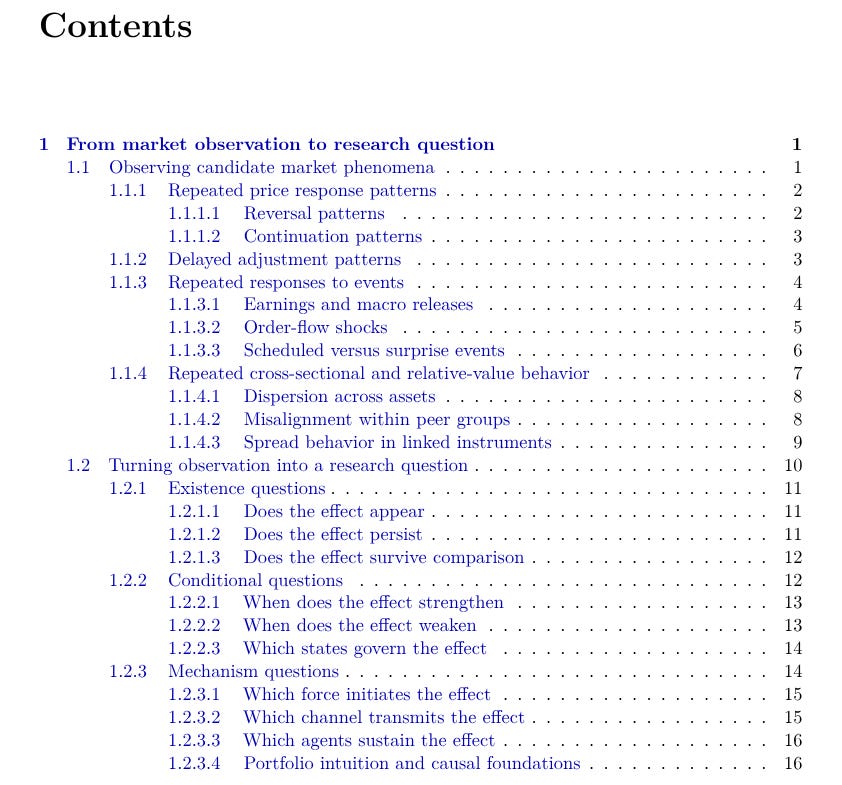
What’s inside:
Market observation. Trading ideas begin with repeated contact between price, volume, liquidity, time, events, and relative asset behavior.
Phenomenon classification. The researcher separates observations into single-instrument responses, delayed adjustments, event-driven reactions, and cross-sectional or relative-value behavior.
Reversal and continuation patterns. Price responses are studied through their lifecycle: initial pressure, dislocation, liquidity return, continuation path, or movement back toward balance.
Delayed adjustment. Some opportunities arise when one instrument reacts first and another follows later because of market clocks, venues, liquidity pools, or transmission delays.
Event-driven research. Earnings, macro releases, order-flow shocks, scheduled events, and surprise events create clean windows for studying price discovery, liquidity withdrawal, drift, dispersion, and repricing.
Cross-sectional and relative-value behavior. We study how dispersion, peer-group misalignment, and linked-instrument spreads reveal hidden capital migration and market friction beneath index-level returns.
Research question formation. A raw idea becomes research-ready when it defines the trigger, asset universe, market state, response window, expected path, and comparison benchmark.
Existence, conditional, and mechanism questions. Research asks whether the effect appears, when it strengthens or weakens, and why it exists through identifiable forces, transmission channels, and sustaining agents.