



Before you begin, remember that you have an index with the newsletter content organized by clicking below.

From trading signals to deployable quantitative strategies
Diary of a Quant – Notebook II presents a broad collection of methods for turning quantitative trading concepts into strategies. It moves from statistical arbitrage and relative value through microstructure, cross-sectional signals, directional trading, and finally portfolio construction, hedging, leverage, drawdown control, and capacity. The emphasis is on testing whether they remain viable after execution costs, liquidity, changing regimes, and portfolio constraints are introduced.
What’s inside:
Building statistical arbitrage and relative-value strategies: Nonlinear cointegration, synthetic-control baskets, functional data analysis, SINDy dynamics, survival models, latent clustering, lead–lag transmission, and event-gated residuals provide alternative ways to identify and trade temporary dislocations while monitoring whether the relationship remains stable.
Modeling microstructure, liquidity, and execution: Order-flow normalization, Level-2 imbalance, fill probabilities, execution-cost shifts, reinforcement-learning execution, VWAP/TWAP switching, passive-order management, venue selection, and post-trade markouts connect theoretical alpha with the mechanics of getting trades filled.
Trading volatility and market structure: Variance, skew, VIX structure, overnight gaps, dealer gamma, and volatility-regime effects are used to formulate strategies around option-implied information, convexity, crash behavior, and changes in the market’s volatility state.
Exploiting cross-sectional, corporate-event, and crowding effects: ETF flows, index reconstitutions, short interest, squeeze risk, earnings drift, analyst revisions, buybacks, insider activity, seasonality, residual momentum, and turnover-aware momentum transform stock-specific information into market- and sector-controlled portfolios.
Designing trend, breakout, futures, and macro signals: Volume-node acceptance, liquidity vacuums, range compression, failed gaps, market breadth, carry–momentum interactions, volatility-confirmed breakouts, policy pressure, and inventory conditions provide systematic ways to distinguish persistent directional moves from false breaks.
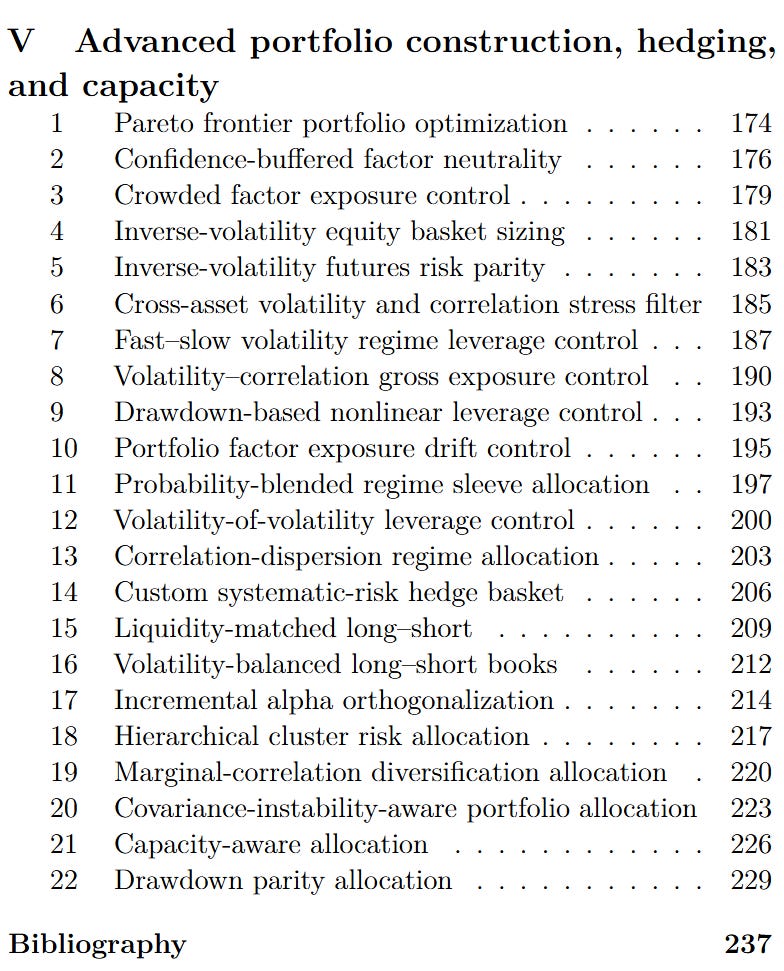
Constructing portfolios and controlling risk dynamically: Pareto optimization, factor neutrality, inverse-volatility sizing, risk parity, correlation stress, volatility targeting, drawdown-based leverage, regime allocation, hedge baskets, hierarchical clustering, and diversification methods determine how individual signals should be combined and scaled.
Accounting for robustness, costs, and capacity: Liquidity matching, covariance instability, capacity-aware allocation, drawdown parity, transaction costs, slippage, financing, and position limits force promising backtests to confront the constraints of live deployment. Each method is intended as a research building block whose assumptions and parameters must be estimated and validated for the specific market and trading horizon.