

Before you begin, remember that you have an index with the newsletter content organized by clicking below.

From market intuition to testable quantitative research
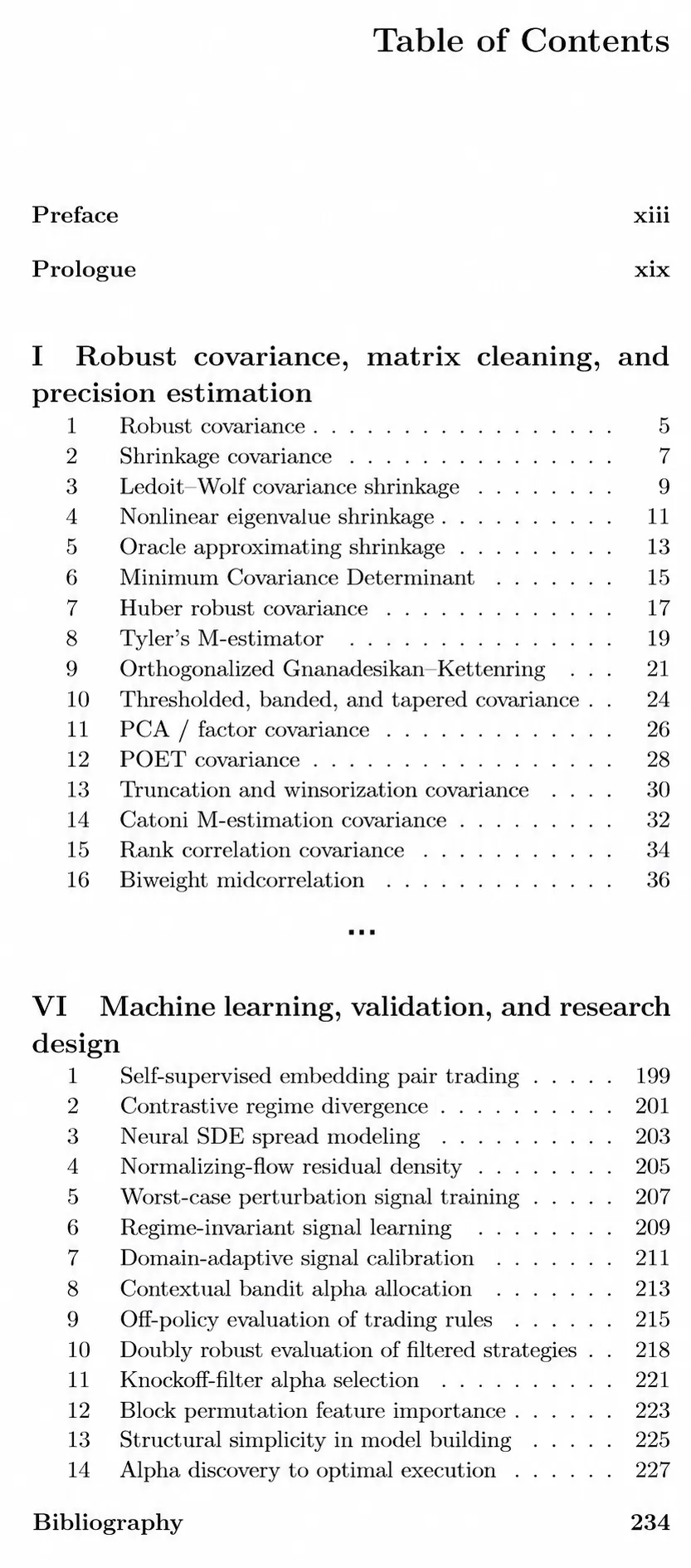
Diary of a Quant — Notebook I presents 100 compact mathematical methods for transforming trading ideas into measurable research specifications. It covers robust estimation, dependence, portfolio construction, information geometry, regime detection, machine learning, and empirical validation. Each entry connects the mathematics to a practical research decision, exposing the assumptions and constraints required to code, compare, test, reject, or refine an idea.
What’s inside:
Stabilizing covariance and precision estimates: Robust estimators, shrinkage, factor models, random-matrix cleaning, structured priors, and geometric techniques reduce estimation noise and prevent unstable covariance matrices from distorting hedges and portfolios.
Measuring dependence beyond correlation: Copulas, tail co-movement, partial-correlation networks, mutual information, HSIC, and distributional distances reveal relationships that conventional linear correlation may fail to detect.
Allocating capital under uncertainty: Regularized optimization, risk parity, volatility targeting, factor-neutral projection, bootstrap diagnostics, and distribution-based risk budgets produce allocations that are more stable and interpretable.
Using information geometry and entropy: Fisher–Rao distance, Bregman projections, geodesics, divergence measures, entropy constraints, and manifold methods describe how market distributions evolve, separate, and deteriorate through time.
Detecting regimes and monitoring edge decay: State-conditioned models, entropy rates, sequential likelihood ratios, optimal transport, and geometric stopping rules identify structural changes and determine when an existing signal is no longer reliable.
Applying machine learning to market structure: Self-supervised embeddings, contrastive learning, neural SDEs, normalizing flows, adversarial training, domain adaptation, and contextual bandits model complex relationships while accounting for changing environments.
Validating and operationalizing research: Off-policy evaluation, doubly robust estimation, knockoff filters, block-permutation tests, structural simplicity, and execution-aware design help distinguish genuine predictive value from overfitting and convert promising formulations into testable strategies.