

Before you begin, remember that you have an index with the newsletter content organized by clicking below.

From a core hypothesis to research framework
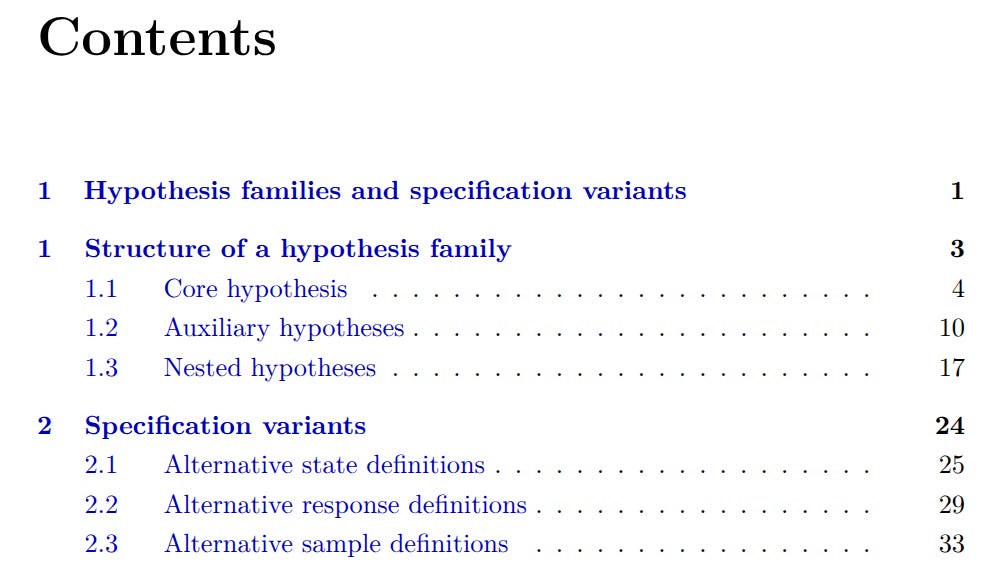
To begin with, quantitative trading research develops through related hypotheses organized around a shared economic mechanism. Following this concept, a hypothesis family defines the central claim and its expected market signature, adds supporting predictions, and narrows the idea into testable formulations. Furthermore, specification variants examine how the same mechanism appears across different market states, response measures, and samples. In fact, researchers assess whether the evidence remains coherent while identifying the conditions under which the proposed effect strengthens, weakens, or disappears.
What’s inside:
Defining the core hypothesis: The researcher specifies what should happen, why it should happen, and which observable footprint should appear in prices, order flow, and temporal dynamics. This foundation anchors every subsequent refinement and test.
Building auxiliary hypotheses: Supporting predictions define where the effect should be strongest, how it should unfold and decay, and which intermediate market traces should accompany the proposed mechanism. These predictions give the core claim additional diagnostic depth.
Organizing nested hypotheses: Broad, intermediate, and narrow claims connect a general economic explanation to asset groups, market regimes, and precise trading rules. Each level preserves the mechanism while clarifying the boundaries of its applicability.
Testing alternative state definitions: Volatility, liquidity, and event-based rules provide different representations of the operating environment. Comparing them reveals whether the expected signature persists across plausible definitions or depends on particular market conditions.
Testing alternative response definitions: Mean returns, distributional features, and price paths capture different aspects of the same effect. Direction, tails, skewness, dispersion, adjustment speed, excursions, and decay help assess whether observed behavior matches the proposed mechanism.
Testing alternative sample definitions: Broad, theoretically filtered, and mechanism-pure samples examine the balance between generality and signal clarity. These comparisons assess portability, isolate the mechanism’s expected operating conditions, and show how its signature changes in broader, noisier data.
Interpreting evidence across specifications: Comparing direction, strength, and internal structure helps assess support for the hypothesis family. Coherent signature can survive changes in magnitude, while divergences help identify specification dependence, refine the claim’s boundaries, or reject unsupported explanations.