

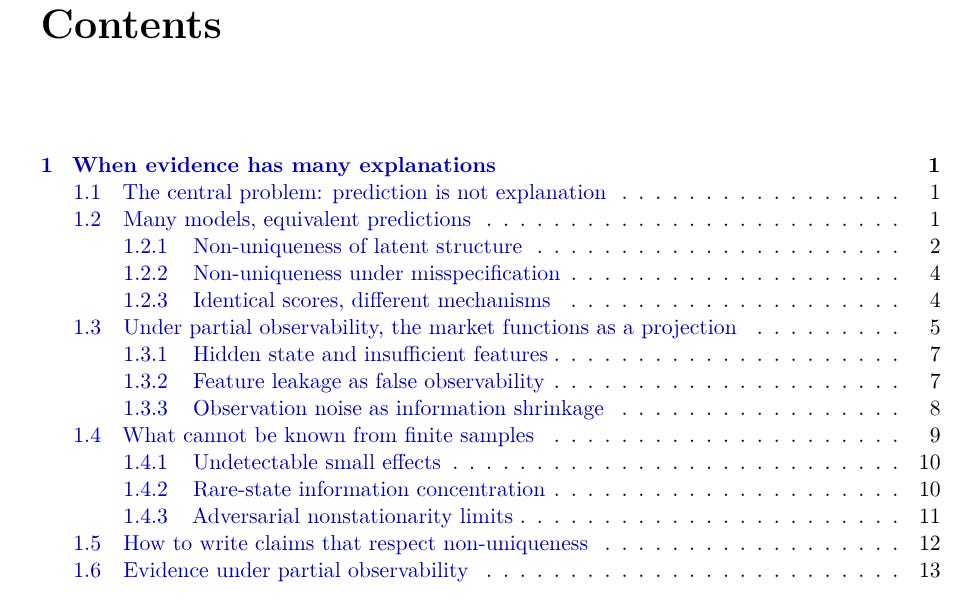
Before you begin, remember that you have an index with the newsletter content organized by clicking on the image below.

When evidence has many explanations
This chapter reframes a trading result as an evidence-backed prediction claim, not as an automatic explanation of why markets move. The goal is to separate what the data supports (a conditional advantage) from what remains underdetermined (a single structural story). The workflow moves from stating the claim, to testing it under refuters, to writing conclusions that match the limits imposed by partial observability, finite samples, and market adaptation.
What’s inside:
Prediction is not explanation. A backtest can validate a mapping from information to outcomes without validating the narrative used to motivate it.
Predictive equivalence. Different model forms can produce the same predictive distribution and the same trading decisions.
Non-uniqueness of latent structure. Hidden regimes, factors, and state sequences admit multiple equivalent representations.
Non-uniqueness under misspecification. In finance, parameters often act as compensators for structural gaps.
Identical scores, different failure modes. Scalar metrics compress behavior into one number and create large equivalence classes.
Partial observability and the hidden state. Public data provides a compressed view of market state.
Leakage as false observability. Small violations of decision-time causality can create apparent structure and strong backtests.
Noise, finite samples, and adaptation limits. Measurement error, sampling variation, and approximation error shrink observable information. Small effects remain hard to resolve, rare-state effects create sample starvation, and adaptive markets shift conditional relationships.
Check a sample of what you will find inside: