

Before you begin, remember that you have an index with the newsletter content organized by clicking on the image below.

Inefficiency as an Information Claim
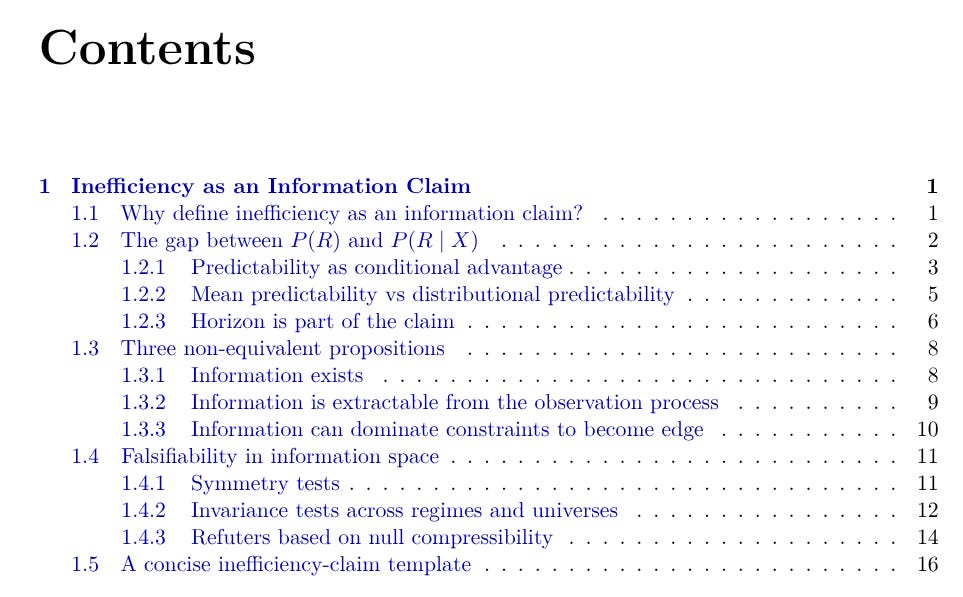
This chapter reframes market inefficiency as a falsifiable information claim: observing X must change the law of a future outcome R. The goal is to separate what is informationally true (structure in conditional laws) from what is merely tradable (edge after constraints). The workflow goes from defining the claim to testing it against strong nulls, and only then deciding whether it deserves execution and portfolio complexity.
What’s inside:
Regression-free bedrock: Why research must begin by defining the object of the claim—not by proposing entries, sizing rules, or backtests.
Prior vs posterior: The core statement: seeing X changes the distribution of R. A signal is any law shift, not just a higher average return.
Predictability as conditional advantage: Predictive value means improvement versus a declared baseline, under a declared scoring rule—not vibes, not anecdotes.
Mean vs distributional predictability: Mean-shift, quantile-shift, and tail-shift claims—and why they are not interchangeable in trading research.
Horizon is part of the claim: The time scale is not a tuning knob: it changes the data-generating process, the noise floor, and what constraints dominate.
Three non-equivalent propositions: Information can exist yet be unextractable, or be extractable but still fail to become edge once constraints are applied.
Falsifiability in information space: Refuters via sign/block/label permutations, invariance checks across regimes and universes, and “null-compressibility” tests.
The claim template: A strict tuple that locks the hypothesis before evidence is examined—and a clear statement of what this framework intentionally does not do.
Check a sample of what you will find inside: