


Table of contents:
Introduction.
Conflict and escalation dynamics.
Energy shock, inflation pass-through, and logistics friction.
Monetary policy, fiscal space, and financial stability channels.
Alliance, war, and strategic competition.
Defense-industrial economics and the cost curve of modern warfare.
Investment implications for multi-asset portfolios.
Audio Note: Before we begin, remember that if you’re accessing this article through the Substack app, you can listen to it instead of reading it. The MarketOps section is best suited for this format.

Before you begin, remember that you have an index with the newsletter content organized by clicking on the image below.

Introduction
Today we map the transmission system through which an Iran-centered war in the Gulf becomes a global pricing regime. The shock already extends far beyond the battlefield. It now moves through oil, equities, shipping, insurance, and industrial planning. Brent crude traded above $119 a barrel in early March 2026 as the conflict widened. Businesses and investors across Europe, Asia, and North America repriced energy exposure, freight risk, and supply-chain vulnerability. That response follows the structure of the system itself. The Strait of Hormuz remains one of the world’s decisive energy corridors. In 2025, flows through the strait averaged about 20 million barrels per day, equal to roughly one-fifth of global petroleum liquids consumption. Around one-fifth of global LNG trade also moved through that corridor.
The central frame is escalation through transmission channels. Missile exchanges raise shipping insurance. Higher shipping insurance raises fuel and freight costs. Higher fuel and freight costs strengthen inflation pressure. Stronger inflation pressure tightens monetary conditions, narrows fiscal room, and increases sensitivity in rates and credit markets. Geopolitical violence therefore enters asset prices through a cumulative macro-financial sequence. That sequence now operates in a constrained policy setting. On January 28, 2026, the Federal Reserve kept the federal funds target range at 3.5% to 3.75%. On February 5, 2026, the European Central Bank kept the deposit facility rate at 2.00%. The Congressional Budget Office projected a $1.9 trillion U.S. federal deficit for fiscal 2026. SIPRI reported that world military expenditure reached $2.718 trillion in 2024. Monetary authorities, fiscal states, and defense systems entered this phase with meaningful pre-existing constraints.
If you want to learn more, you’ll find more information here:

Read through that lens, the conflict functions as a regime test for portfolios, governments, and industrial systems. It tests whether logistics networks can reroute under pressure. It tests whether central banks can preserve credibility under renewed energy inflation. It tests whether fiscal states can absorb a larger strategic bill while debt burdens remain elevated. It also tests whether defense-industrial supply chains can sustain a modern cost curve shaped by expensive interceptors, long lead times, and repeated replenishment cycles. For that reason, the analysis that follows moves from escalation to energy pass-through. Then to monetary and fiscal constraints. Then to alliance management and defense-industrial economics. And finally to the asset-pricing implications that matter most for multi-asset investors in a world where geopolitical shocks increasingly behave like macro transmission systems rather than isolated events.

Conflict and escalation dynamics
The market narrative around an Iran-centered conflict that expands across the broader Middle East, with spillovers into Gulf targets, regional infrastructure, and allied basing arrangements. That matches the pattern described by major wire services: a U.S.-Israeli campaign against Iran has coincided with missile and drone strikes across multiple Gulf states and with pressure on energy logistics and critical infrastructure.

A core structural feature of this conflict phase is its multi-node geometry. It links air and missile defense networks, energy export platforms, sea lanes, and diplomatic posture into a single operating system. Missile-defense radars and communications sites have emerged as strategic targets because they anchor interception chains for systems deployed by the United States and regional partners. This target set differs from a narrow, territory-bound war and aligns with a systems war logic: degrading sensors can reduce the marginal value of interceptors and raise the per-attack success probability for drones and missiles.
A gap between initial strike objectives and post-strike political end-states, framed as the absence of a defined phase two. A related public signal appeared in reporting from the Financial Times, which cited Senator Mark Warner’s view that administration briefings lacked an articulated next-step plan for the aftermath of the military campaign. In investor terms, that type of gap raises the probability distribution over duration, geographic spread, and infrastructure targeting, which then feeds into commodity risk premia and credit repricing.
Escalation pathways come from three channels that interact. The first is kinetic interaction across dense air-defense coverage, where a high volume of launches produces stress on interceptors, radars, and maintenance cycles. The second is economic coercion via chokepoints and storage constraints, which can force producers to curb output when exports face friction. The third is alliance-management stress, especially when operations touch bases, ports, and treaty obligations for states that seek distance from a campaign.
At the strategic layer, European governments have produced a legal framing that increases political distance from kinetic participation, which raises burden-sharing uncertainty and can bring additional volatility around NATO posture and basing in Southern Europe. This divergence matters for markets because alliance cohesion influences sanction coordination, shipping escorts, and the credibility of de-escalation off-ramps.

Conflict intensity has already shaped equity pricing. Intraday drawdowns in U.S. equities exceeded one thousand Dow points in at least one session during the first week of March, with oil-price acceleration as a primary driver in contemporaneous reporting. That linkage between war-duration uncertainty and inflation risk is central: markets can price tactical battlefield outcomes, yet they price duration and breadth through commodities, rates, and credit spreads.
Energy shock, inflation pass-through, and logistics friction
The dominant macro transmission mechanism in this phase is the energy channel, amplified by chokepoint concentration. The Strait of Hormuz serves as a major conduit for global petroleum liquids and for liquefied natural gas trade. The U.S. Energy Information Administration estimated average oil flows through the strait around twenty million barrels per day in 2024, which aligns with about one-fifth of global petroleum liquids consumption, and it assessed about one-fifth of global LNG trade transiting the strait in 2024, primarily from Qatar. The International Energy Agency provides a parallel framing, with LNG transiting volumes around one-fifth of global LNG trade and seaborne oil trade shares tied to Hormuz flows.
In this conflict phase, shipping disruption and storage constraints have emerged as binding constraints for producers and buyers. Recent reportes indicate producer firms have managed offshore output around storage restrictions and have used alternative export routes, while the broader war environment has pushed some Gulf producers toward output curtailment and force majeure declarations. In parallel, European policymakers convened contingency coordination groups after a sharp rise in regional gas prices.
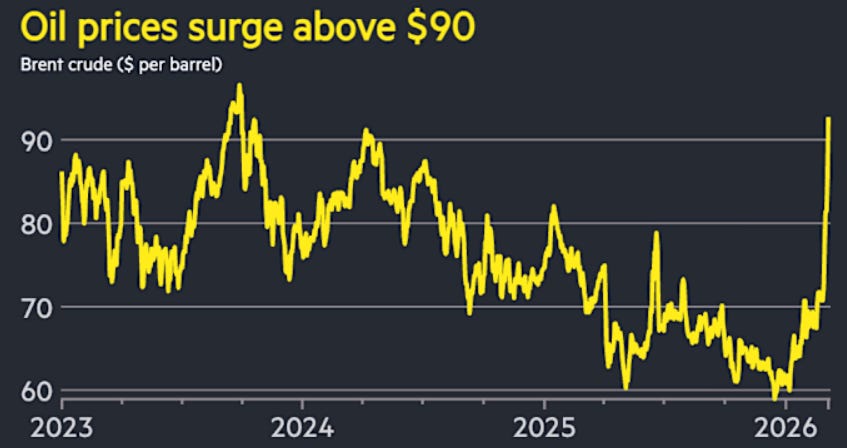
Price action in crude and refined products has reflected a risk-premium regime. In early March, Brent traded in the mid-to-high eighties and moved into the nineties in subsequent sessions, while U.S. benchmarks also rose with large daily moves. A key market feature is convexity: small changes in expected duration of disruption can produce large changes in expected supply deficit, inventory draw rates, and implied volatility in oil options.
European natural gas provides a second amplification channel because LNG availability and shipping routes link Asia and Europe through spot competition. A surge exceeding fifty percent in European gas prices after the conflict began to disrupt key flows and to affect perceptions of LNG supply security, with storage levels and refill paths becoming a policy focus. This dynamic creates a macro wedge between the United States and the euro area: U.S. gas prices can move on domestic balances, whereas Europe clears at the margin through LNG cargo competition.

Freight and air logistics form a third channel that carries inflation into tradables beyond energy. The Washington Post described broad disruption to air and sea traffic, with airfreight rates between Asia and Europe rising by about forty-five percent in its reporting, alongside stalled shipping around Hormuz and suspended new shipments by major carriers. A shipping surcharge response reflects the same mechanism: higher fuel costs and routing risk raise the delivered price of intermediate and final goods, with the largest impulse for time-sensitive goods.
Inflation pass-through operates through headline energy prices, second-round wage and margin dynamics, and inflation expectations. Energy-driven inflation blocks rate cuts by the Federal Reserve and implies tighter conditions across Europe. A similar dilemma appears in mainstream reporting that highlights central bank hesitation under an oil-driven inflation impulse. Several analysis ahead of the strikes assessed that a prolonged disruption could push oil toward one hundred dollars and add roughly six to seven tenths of a percentage point to global inflation, illustrating how the energy channel can dominate the inflation path when the shock persists.
Monetary policy, fiscal space, and financial stability channels
The monetary side of the macro regime is shaped by a clash between disinflation progress and an energy shock that lifts headline inflation and shifts risk distributions. The Federal Open Market Committee held the target range for the federal funds rate at 3.5% to 3.75% in its January statement. A patient stance among Fed officials, with emphasis on holding policy steady while monitoring inflation dynamics and the war-driven energy impulse. That combination gives the policy path a more state-contingent structure: energy moves compress the room for easing, while labor-market weakening raises the weight on employment objectives.

In the euro area, the European Central Bank kept key rates unchanged in early February, with a deposit facility rate at 2.00% and related corridor rates as published by the ECB. The euro area energy shock risk differs from the U.S. risk because net import dependence remains meaningful and because the marginal LNG price clears through global competition. That asymmetry can widen growth and inflation dispersion within advanced economies and can shape currency and rate differentials.
Fiscal capacity and debt service costs form an additional constraint layer. The U.S. Congressional Budget Office projected a deficit of $1.9 trillion in fiscal year 2026 and a rising path for federal debt, reaching 120 percent of GDP by 2036 in its baseline outlook. Rising net interest costs represent a large share of that story, with outside analyses drawing from the same baseline highlighting a doubling path for net interest outlays across the next decade. These fiscal conditions matter for geopolitics because large, persistent deficits reduce political room for sustained high-cost expeditionary operations and raise the sensitivity of sovereign financing conditions to inflation shocks.

Private-sector balance sheet stress and credit repricing tighten the feedback loop between rates and growth. U.S. private credit defaults reached a record 9.2% in 2025 in a Fitch dataset, with floating-rate structures linking cash-flow stress to policy rates and to credit spreads. Household stress measures show a parallel dynamics: the Federal Reserve Bank of New York reported aggregate delinquency worsening in late 2025, with 4.8% of outstanding household debt in some stage of delinquency, and a rise in serious delinquency flows for several categories. Consumer balance sheets carry fatigue from prior inflation cycles, which raises the probability that an energy shock translates into demand compression rather than into a clean growth-through-inflation regime. The combination of household stress and private credit defaults suggests a financial system that prices duration risk in the real economy with greater sensitivity to energy-driven inflation.
Markets have begun to price this regime as a volatility state change rather than as a single event shock. The VIX moved above 20 amid the conflict, with attention to shock-absorber trades and hedging demand. Equity selloffs and partial rebounds have reflected a tug-of-war between the energy/inflation channel and the expectation that logistics protection or de-escalation steps might cap the duration of disruption.